








Laser Cutting Aluminum Sheets and Pipes
Aluminum laser cutting produces precise components from both flat sheets and tubular materials. From custom panels to lightweight frames, it offers flexible design options for a wide range of fabrication and assembly requirements.
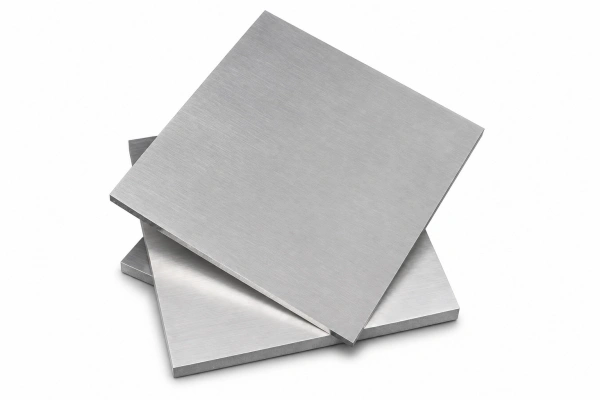
Aluminum sheet laser cutting uses a focused laser beam to create accurate contours, holes, and intricate patterns in flat material. Its narrow kerf and flexible cutting paths make it suitable for custom panels, brackets, housings, and decorative parts. Designs can be changed through the cutting program without dedicated dies, supporting both prototypes and repeat production.
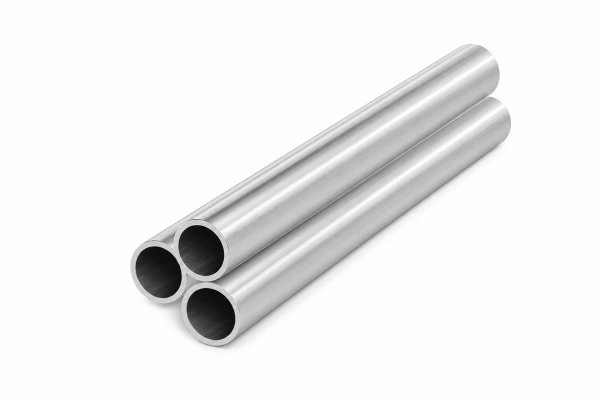
Aluminum pipe laser cutting creates holes, slots, notches, and shaped ends in round, square, and rectangular tubes. Combining these features in one cutting process can reduce separate sawing and drilling operations and repeated handling. Accurate cut features help parts fit together for assembly and welding, making the process suitable for frames, furniture, railings, and equipment structures.
Why Use Laser Cut Aluminum?

Once fiber laser technology matured, it solved the long-standing problem of aluminum’s high reflectivity. Compared to punch presses, plasma cutters, waterjets, and CNC machines, it offers the best overall value for aluminum sheet metal parts. Fiber lasers are inherently better suited for aluminum. Aluminum is a highly reflective and highly thermally conductive material; in the early days, CO₂ lasers were prone to reflection, which often damaged the lenses. Today, fiber lasers operate at a wavelength of approximately 1070 nm, which aluminum absorbs much more effectively. Combined with reflective isolation and protective measures, cutting aluminum has become a routine task rather than a high-risk process.
Laser cutting is a non-contact process that applies no punching force and produces a small heat-affected zone, making it less likely for thin sheets to warp. It offers stable tolerances of up to ±0.1 mm, with narrow cut edges and minimal burrs. Many workpieces require no grinding or deburring after cutting, eliminating the need for subsequent processing steps. This makes it ideal for precision components such as enclosures, new energy equipment, photovoltaic components, and aluminum housings; At the same time, the equipment offers exceptional flexibility and requires no tooling. Unlike punch presses, which are only suitable for high-volume, simple parts and require new tooling for each design change, laser cutting allows for the production of irregular shapes, small holes, and patterns simply by importing drawings. It offers significant advantages for prototyping, small-batch production, and diverse, non-standard sheet metal orders.
Aluminum Laser Cutting Thickness and Power
Choosing the Right Laser Power
For laser cut aluminum parts, choose laser power based on the alloy, material thickness, assist gas, and required cutting speed and edge quality. Use the reference ranges below to compare configurations, then confirm the settings with a sample cut before batch production.
The table summarizes aluminum cutting data from the Raycus cutting parameter database. Reference ranges exclude entries marked for trial cutting, while maximum listed thicknesses include these entries where indicated by an asterisk.

Aluminum Cutting Thickness by Laser Power
| Potencia del láser | Reference Cutting Range | Maximum Listed Thickness |
|---|---|---|
| 1,5 kW | 1–3 mm | 3 mm |
| 2 kW | 1–4 mm | 4 mm |
| 3 kW | 1–6 mm | 8 mm* |
| 4 kW | 1–8 mm | 10 mm* |
| 6 kW (34 μm core) | 1–14 mm | 16 mm* |
| 6 kW (75 μm core) | 1–14 mm | 20 mm* |
| 12 kW | 1–25 mm | 40 mm* |
| 15 kW | 1–30 mm | 50 mm* |
| 20 kW | 1–30 mm | 60 mm* |
| 30 kW | 1–30 mm | 60 mm* |
| 40 kW | 5–70 mm | 100 mm* |
* Trial-cutting parameter. The source database identifies these settings for sample cutting or small batches and does not recommend them for routine mass production. Reference ranges exclude these trial-cutting entries.
All rows use nitrogen-assisted aluminum cutting data. Two 6 kW fiber-core configurations are shown separately because their maximum listed thicknesses differ.
Ranges and maxima summarize the thicknesses listed in the database, not guaranteed production limits or minimum cutting capabilities. Confirm the required edge quality and cutting speed for your aluminum alloy and machine configuration.
Related Products
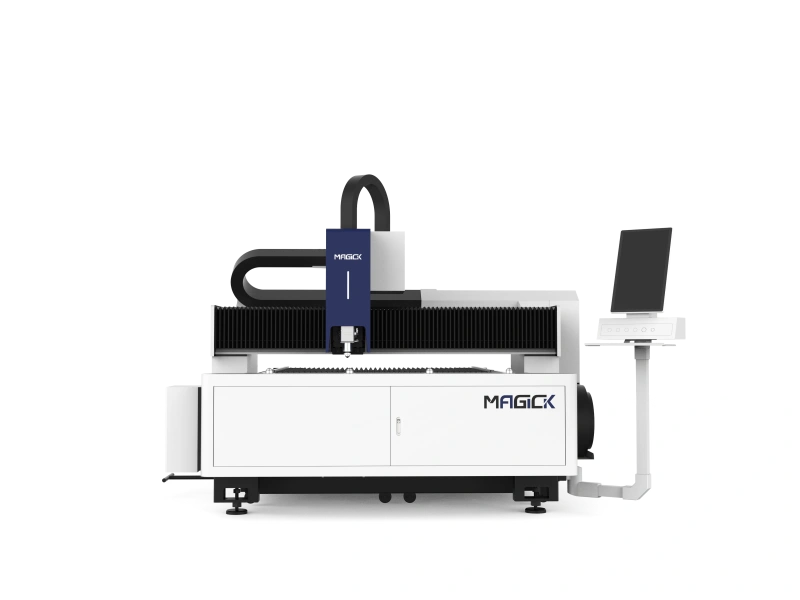
MK-S Single Table Fiber Laser Cutting Machine
A flexible sheet metal cutting solution with an open-table design, suitable for small workshops and diverse aluminum cutting needs.
View MK-S Details
Máquina de corte por láser de fibra con mesa de intercambio MK-E
An exchange table design that reduces loading downtime and supports efficient batch production of aluminum processing needs.
View MK-E Details
Máquina de corte por láser de tubos MK-TY
A cost effective tube cutting solution with a compact layout and reduced end remnants, suitable for light to medium-duty aluminum tube cutting.
View MK-TY Details
MK-T2C Dual-Chuck Tube Laser Cutting Machine
A side-mounted dual-chuck design that simplifies tube loading and supports stable cutting for small and medium-sized metal fabrication workshops.
View MK-T2C DetailsArtículos relacionados
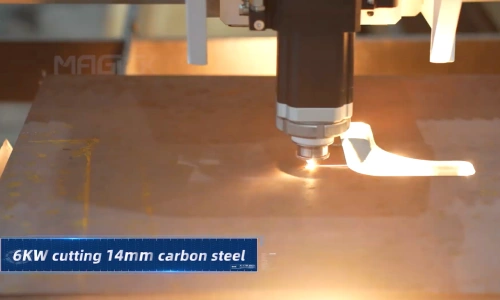
Laser Cutting Steel Sheet: A Practical Guide for Manufacturers
Learn how laser cutting steel sheet works, how to assess 20 mm cutting, edge quality and cost, and how to choose the right fiber laser machine.
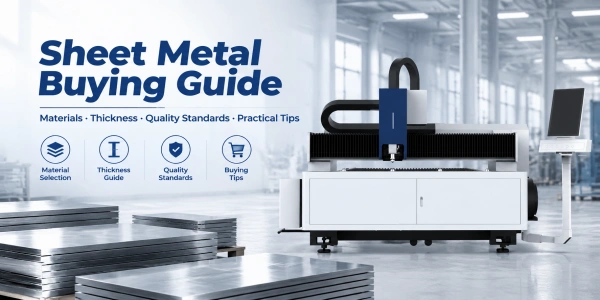
Guía de compra de cortadoras láser de fibra: potencia, precio y características técnicas clave
Compare fiber laser cutter power, prices and key specs. Find the right configuration and request a tailored quote.
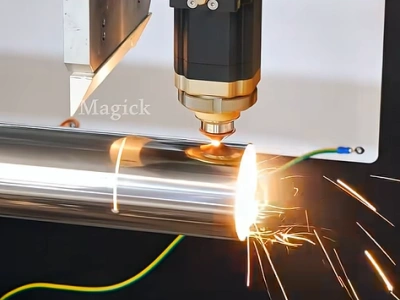
¿Cómo funciona una cortadora láser?
¿Cómo funciona una cortadora láser? Descubre cómo la focalización del láser, el gas auxiliar y el movimiento CNC permiten realizar cortes precisos en metal.