








Choosing a fiber laser for metal cutting directly determines your shop’s edge quality, per-part cost, and daily throughput. Whether you run a high-mix job shop or an OEM production line, selecting the right fiber laser for cutting metal requires matching wattage, table format, cutting head optics, and assist gas capacity to your core materials and monthly volume. This guide details the technical benchmarks and MAGICK sheet metal fiber laser systems you need to specify the right machine.
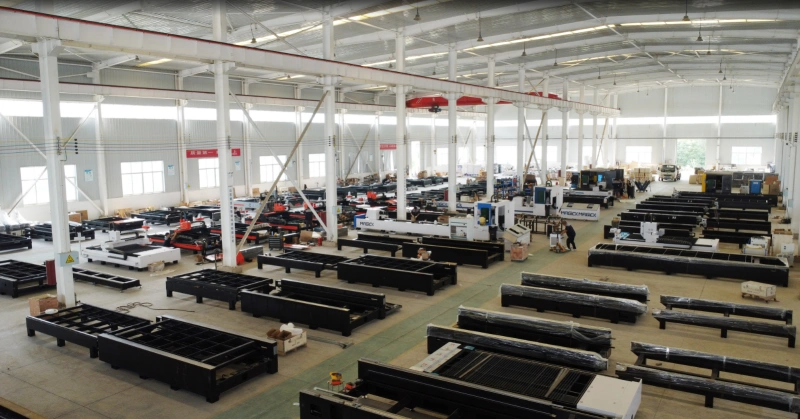
What Is a Fiber Laser for Cutting Metal?
A fiber laser for cutting metal is a solid-state system that generates a beam inside an optical fiber doped with rare-earth elements—typically ytterbium—and delivers it directly to the cutting head through a flexible fiber-optic cable. Operating at a 1,070 nm near-infrared wavelength, it focuses high energy density onto a spot smaller than 0.2 mm.
Because metals absorb the 1,070 nm wavelength far more efficiently than CO₂ beams, a fiber laser cutting machine for metal achieves faster pierce times, higher feed rates, and 30% to 45% wall-plug electrical efficiency.
How Does Fiber Laser Cutting for Metal Work?
Fiber laser cutting for metal uses a non-contact thermal separation process driven by a CNC motion controller. As outlined in TRUMPF laser cutting technology standards, the focused beam heats the workpiece along a programmed contour until the metal melts or vaporizes, while a coaxial jet of pressurized assist gas ejects molten material from the kerf.
Three mechanisms control cut quality:
- Beam Focusing and Height Control: Collimating and focusing optics set the spot size and focal position, while a capacitive sensor holds a constant nozzle-to-sheet standoff across uneven plates.
- Assist Gas Dynamics: Oxygen drives exothermic flame cutting in thicker carbon steel at up to 6 bar. High-pressure nitrogen (10 to 20 bar) performs fusion cutting in stainless steel and aluminum to prevent oxidation. Compressed air works for thin carbon steel and aluminum when slight edge oxidation is acceptable.
- CNC Motion Synchronization: High-torque servo drives (such as Yaskawa motors paired with YYC rack-and-pinion transmission and BOCHU CNC control) coordinate axis motion with real-time laser power modulation, maintaining ±0.02 mm positioning accuracy.
What Metals Can a Fiber Laser Cutting Machine Cut?
A fiber laser cutting machine for metal processes all major ferrous and non-ferrous sheet and plate alloys. Material properties dictate assist gas choice and minimum wattage.
Acero al carbono
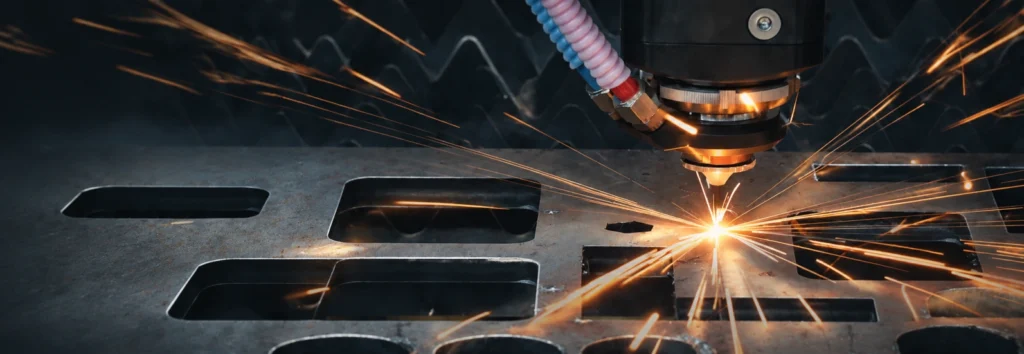
Carbon steel is the most straightforward metal to cut. Thin sheets (1–4 mm) cut rapidly with nitrogen or compressed air, leaving clean, paint-ready edges. Medium and thick plates (6–30 mm+) use oxygen assist gas to sustain an exothermic reaction that extends capacity and keeps edge roughness low.
Acero inoxidable
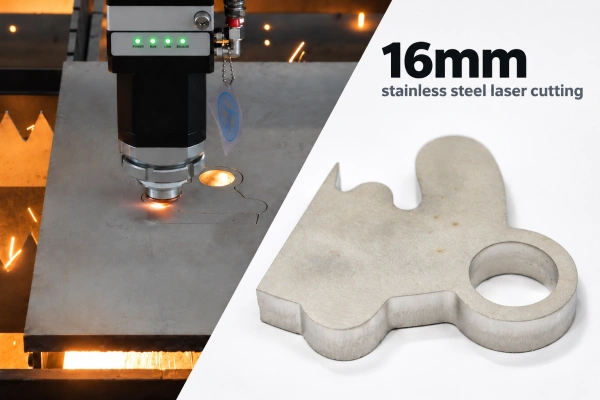
Stainless steel requires high-pressure nitrogen to shield the molten kerf from oxygen and prevent black oxide buildup. Nitrogen fusion cutting produces bright, burr-free edges ready for welding or bending without secondary grinding.
Aluminio

Aluminum conducts heat rapidly and reflects infrared light, requiring higher power density to initiate and sustain the cut. Nitrogen delivers oxide-free edges for aerospace and architectural panels, while compressed air suits general brackets where minor edge darkening is acceptable.
Brass and Copper
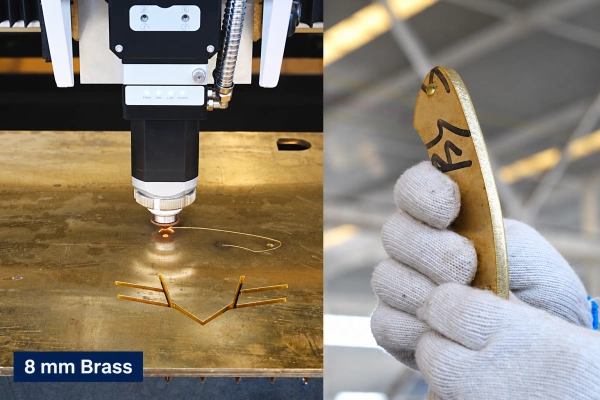
Brass and copper combine high thermal conductivity with high reflectivity at 1,070 nm. Fiber systems cut brass cleanly with nitrogen and process copper reliably using oxygen (for thicker gauges) or high-pressure nitrogen when equipped with optical back-reflection protection.
How Much Fiber Laser Power Do You Need for Metal Cutting?
Selecting wattage is the most critical budget and productivity decision. Underpowering bottlenecks throughput; overpowering ties up capital in unused capacity.
Choose Power by Regular Cutting Thickness
Size your laser power around the thickness range covering 80% of your daily jobs rather than occasional thick-plate outliers:
| Potencia del láser | Carbon Steel (Production) | Stainless Steel (Nitrogen) | Aluminum (Production) | Recommended MAGICK Series |
| 1.5 kW – 3 kW | 1 – 12 mm (O₂) | 1 – 6 mm | 1 – 5 mm | MK-S / MK-P |
| 6 kW | 1 – 20 mm (O₂) | 1 – 12 mm | 1 – 12 mm | MK-E Exchange Table / MK-S |
| 12 kW | 1 – 30 mm+ (O₂ / Air) | 1 – 25 mm | 1 – 20 mm | MK-G High-Power / MK-E |
| 20 kW – 40 kW | 6 – 50 mm+ | 6 – 40 mm+ | 6 – 35 mm+ | MK-G / MK-H Bevel Series |
Match Power to Monthly Production Volume
Cutting speed scales nonlinearly with wattage on thin and medium gauges. Upgrading from 3 kW to 6 kW more than doubles nitrogen speed on 3–6 mm stainless and mild steel. Shops running two or more shifts or over 50 tons per month achieve lower per-part costs with 6 kW or 12 kW systems.
Check High-Reflective Metal Protection
If you cut aluminum, brass, or copper regularly, verify the laser source includes hardware-level back-reflection isolation. Without optical protection, reflected 1,070 nm energy can travel back into the fiber and damage resonator modules.
How to Choose a Fiber Laser Cutting Machine for Metal
Beyond wattage, five hardware and support factors determine uptime when buying a fiber laser cutting machine for metal.
Cutting Area
Match the bed to your standard raw sheet size to eliminate pre-shearing. Common formats start at 1,500 × 1,500 mm on compact enclosures and scale through 3100 × 1550 mm (5 × 10 ft) on the MK-S single-table series up to 6200 × 2600 mm on large-format bevel platforms. Shops processing both flat sheets and Ø15–230 mm round pipes can consolidate onto a sheet and tube dual-use machine.
Laser Source and Cutting Head
Pair a proven industrial fiber resonator—such as IPG, Raycus, MAX, or RECI—with a Raytools autofocus cutting head rated above your laser wattage. Verify dual-circuit water cooling, sealed optical cavities, and cover-glass contamination sensors.
Automation and Loading Options
An open single table fits low-volume job shops, whereas a dual-pallet exchange table cuts changeover downtime to 10–30 seconds for continuous batch production. For strict operator safety and fume containment, choose a fully enclosed MK-P platform with laser-protective viewing windows and CE/FDA compliance.
Software and Control System
Select a BOCHU CNC controller with automatic nesting, common-line cutting, micro-jointing, fly-cutting, and pierce detection. Efficient nesting software cuts sheet scrap by 8% to 15%.
Service and Spare Parts
Uptime depends on fast access to nozzles, ceramic rings, and protective lenses. Confirm factory-direct 2–3 year warranty coverage, remote CNC diagnostics, and export spare-parts availability before purchasing.
Fiber Laser Cutting Machines for Metal Fabrication Applications
Fiber laser cutting machines for metal fabrication serve as the primary blanking solution across four core industries:
Fabricación de chapas metálicas
Job shops use fiber lasers for rapid prototyping and short-run orders across mixed gauges. Direct DXF/DWG import eliminates hard tooling and compresses lead times.
Machinery and Equipment Manufacturing
Agricultural, construction, and material-handling OEMs deploy 6 kW–40 kW systems to cut heavy brackets, chassis plates, and structural gussets with tight tolerances for robotic welding.
Recambios de automóvil
Tier-1 and Tier-2 suppliers cut exhaust components, battery trays, heat shields, and stamped blanks with minimal thermal distortion and burr-free edges.
Electrical Cabinets and Enclosures
Switchgear and server-rack builders cut 1–3 mm cold-rolled and galvanized steel using compressed air or nitrogen, producing clean louvers and knockouts ready for powder coating.
Fiber Laser Cutting for Metal vs. CO₂ Laser Cutting
When comparing fiber laser cutting for metal against CO₂ systems, fiber leads on speed, efficiency, and maintenance:
| Comparison Factor | Fiber Laser (1,070 nm) | CO₂ Laser (10.6 µm) |
| Thin-to-Medium Metal Speed | 2× to 3× faster on ≤ 6 mm sheet | Slower linear feed rates |
| Electrical Efficiency | 30% – 45% wall-plug efficiency | 8% – 12% wall-plug efficiency |
| Reflective Metals | Cuts aluminum, brass, copper reliably | High risk of back-reflection damage |
| Optical Maintenance | Sealed fiber; no mirror alignment | Requires mirror cleaning & alignment |
| Non-Metal Cutting | Requires hybrid fiber + CO₂ (e.g., MK-DC) | Cuts plastics, wood, and organics |
For dedicated metal shops, fiber lasers deliver lower hourly operating costs and faster payback. Hybrid or CO₂ systems remain relevant only when cutting acrylic or wood alongside metal.
Preguntas frecuentes
Is a Fiber Laser Best for Cutting Metal?
Yes. For sheet and plate metal from 0.5 mm to 30 mm+, fiber lasers are the fastest, most energy-efficient, and lowest-maintenance thermal cutting method, outperforming CO₂ and plasma on precision and per-part cost.
What Thickness of Metal Can a Fiber Laser Cut?
Industrial fiber systems cut from 0.5 mm foil up to 50 mm+ carbon steel and 40 mm stainless steel depending on wattage. A 3 kW machine cuts up to 16–20 mm carbon steel (production optimal up to 12 mm), while 12 kW–40 kW systems handle heavy plate.
What Fiber Laser Power Is Suitable for Stainless Steel?
Use 1.5 kW–3 kW for 1–6 mm stainless steel, 6 kW for 1–12 mm, and 12 kW+ for 12–25 mm+ plate when cutting with high-pressure nitrogen for bright, oxide-free edges.
Can a Fiber Laser Cut Aluminum, Brass, and Copper?
Yes. Fiber laser cutting for metal processes aluminum, brass, and copper cleanly because metals absorb the 1,070 nm wavelength efficiently. Specify a source with back-reflection protection and use nitrogen assist gas for burr-free edges.
Select a Fiber Laser Cutting Machine for Your Production Needs
Choosing the right fiber laser cutting machine for metal means aligning your core materials, target thickness, and monthly tonnage with the proper wattage, cutting head, and table automation. Investing in the right fiber laser for metal cutting eliminates secondary grinding, minimizes scrap, and scales cleanly as production grows.
Ready to specify your machine? Share your target metals, maximum thickness, and monthly sheet volume with MAGICK’s engineering team for a tailored machine configuration, cutting-speed chart, and factory-direct quote: Request a Machine Quote on MAGICK.