
For metal fabrication companies that work with both flat metal sheets and tubes, purchasing one laser cutting machine to do both operations might not be worth it. The sheet-and-tube laser cutting system performs the same type of job and gives the companies a chance to expand their capabilities without needing to buy additional equipment.
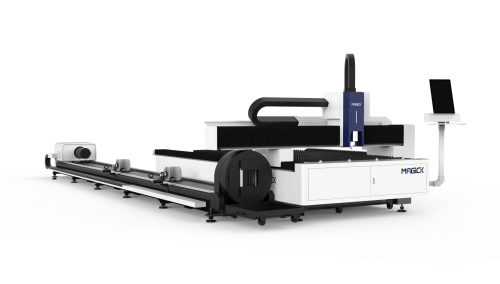
Nevertheless, selecting a combined machine means more than just picking a suitable laser power or looking at prices. Tube dimension, cutting frequency, machine configuration, and production schedules are some of the factors that influence the feasibility of the investment.
Using a machine that is efficient in a small shop might become an obstacle in a factory dealing with high orders per day.
The guide describes how to assess your production needs, compare the configurations of machines, and choose a combined machine that would be beneficial for your business in the long run.
1. Is a Sheet and Tube Laser Cutting Machine Right for Your Business?
It is relevant to mention your factory’s actual utilization of metal sheets and tubes before getting into specifications comparison.
For instance, while a manufacturer producing electrical cabinets mostly works with the flat sheet metal, sometimes they may have to use square tubes for the supporting frames. If the manufacturer is to buy a tube laser cutter specifically for these occasional orders, they may end up with expensive equipment being idle for a good part of the time.
On the other hand, a combination machine allows the manufacturer to engage in both processes through only one machine.
The decorative side is another thing with a manufacturer working with thousands of tube parts every day. For this manufacturer, if tube cutting takes up a lot of the work, a specialized tube laser cutter will be a much more suitable option with its better material handling, automation, and productivity.
The primary advantage of a combination machine is in its flexibility rather than great production speed.
| Factor | Sheet and Tube Combination Machine | Two Separate Machines |
|---|---|---|
| Initial investment | Generally lower | Generally higher |
| Factory space | Usually requires less space | Requires two production areas |
| Production flexibility | Handles both sheets and tubes | Each machine handles a dedicated task |
| Simultaneous cutting | Generally not possible | Possible |
| High-volume production | Limited by shared machine capacity | Better suited to parallel operations |
| Best application | Mixed, small-to-medium batch production | Continuous, high-volume production |
A dual use laser cutting machine is particularly useful for general metal fabrication, custom machinery manufacturing, equipment enclosures, metal furniture, and workshops handling diverse customer orders.
On the other hand, factories with consistently heavy workloads in both sheet and tube cutting should carefully evaluate whether two specialized machines would be more productive.
2. Key Factors to Consider Before Buying
Once you have determined that a combination machine suits your production model, the next step is matching its capabilities to your actual materials and cutting requirements.
Laser Power: Focus on Material Thickness and Productivity
Laser power is often the first specification buyers compare, but choosing a higher wattage does not automatically result in a better investment.
For businesses primarily cutting thin carbon steel and stainless steel, a 3kW system may provide sufficient performance, depending on the required cutting speed and edge quality.
A 6kW configuration may be more appropriate when processing thicker materials or when faster cutting and piercing are important to daily production.
Higher-power systems can offer additional capabilities, but they also affect the overall equipment investment and supporting requirements.
More importantly, nominal laser power alone does not determine cutting performance. Material grade, assist gas, cutting head, process parameters, and required edge quality also matter.
Instead of selecting a machine based only on its maximum advertised cutting thickness, ask the manufacturer to test your most frequently processed materials.
A machine that cuts your regular production parts efficiently will often deliver more value than one configured for occasional extreme thicknesses.
Sheet Working Area: Match the Machine to Your Standard Material Sizes
The maximum dimensions of flat sheets that can be processed without any manual movement depend on the working area.
Common designs are 3000 × 1500 mm, 4000 × 2000 mm, and 6000 × 2000 mm.
A 3000 × 1500 mm all in one laser cutting machine is ideal for workshops that require processing of sheets of standard sizes, as well as the elements manufactured from smaller sheet metal. For those involved in cutting the sheets of larger dimensions, the larger working space will solve the issue of repositioning of the sheet.
Nevertheless, the presence of a larger cutting table requires more space for installation and loading of material.
When you compare the machines, pay attention to the footprint of the equipment, besides the cutting area.
Tube Cutting Capacity: Diameter Is Only Part of the Specification
Tube cutting capability requires closer attention because tube dimensions involve more variables than flat sheets.
Important factors include tube shape, outside dimensions, wall thickness, processing length, workpiece weight, and chuck clamping capacity.
Round pipes, square tubes, and rectangular tubes place different demands on the machine’s rotary system.
For example, a machine advertised with a maximum round-tube diameter of 230 mm may not support every rectangular profile with a similar outside dimension.
The chuck opening, rotating clearance, clamping method, and profile geometry must all be considered.
Long tubes introduce another challenge: maintaining adequate support during rotation. Without suitable supporting mechanisms, tube sagging or vibration can affect cutting stability, particularly when working with heavier materials.
Buyers should also confirm the usable cutting length, loading requirements, and expected remaining tail material.
If your factory frequently processes heavy structural profiles, thick-wall tubes, or complex bevel cuts, a specialized tube cutting machine may be the more appropriate solution.
Cutting Accuracy and Machine Stability
When comparing positioning accuracy, repeat positioning accuracy, and maximum travel speed, remember that these figures describe different aspects of machine performance.
A high maximum travel speed does not guarantee faster production on complex parts.
Similarly, the actual dimensional accuracy of a finished component depends on more than the positioning accuracy listed in a machine specification.
Cutting parameters, mechanical stability, material characteristics, and tube clamping all influence the final result.
For practical evaluation, request cutting samples containing small holes, narrow slots, internal corners, and representative tube joints.
These features provide a more useful indication of real production performance than specifications alone.
3. Choosing the Right Machine Configuration
Not all sheet and tube laser cutting machines are built for the same production environment.
The machine structure affects loading efficiency, operator access, safety management, and overall workflow.
MAGICK offers several configurations designed around these different requirements.
Standard Sheet and Tube Laser Cutting Machines: A Practical Starting Point
A conventional sheet and tube combination machine provides flat sheet cutting and rotary tube processing within one system.
The MAGICK MK-ST series is designed for businesses looking for flexible cutting capabilities without investing in two separate systems.
This configuration can be a sensible option for smaller fabrication workshops, custom metalworking businesses, and manufacturers whose cutting requirements change between projects.
It is especially relevant when purchase budget and production flexibility are more important than maximum continuous throughput.
Exchange Table Sheet and Tube Laser Cutting Machines: Reduce Sheet Loading Interruptions
In numerous workshop environments, laser cutting machines are not the only elements that influence output.
The operators also spend time processing finished parts, getting rid of scrap material and feeding new sheets into the machines.
An exchange table enables one pallet to prepare materials while another is used for production operations, minimizing downtime between cutting projects.
The MAGICK MK-ET series combines sheet and tube processing with an exchange table configuration.
For businesses with substantial sheet cutting demand and occasional tube orders, this can provide a better workflow than a single-table machine.
However, an exchange table should not be confused with independent dual-machine production. Sheet and tube operations still share the cutting system.
Enclosed Sheet and Tube Laser Cutting Machines: Prioritize Protection and Workshop Conditions
Laser safety and fume management are also important when selecting industrial cutting equipment.
A protective enclosure can help limit access to the cutting area and contain laser radiation and process emissions when correctly engineered and operated.
The MAGICK MK-CT series is designed around a protective closed configuration with sheet and tube cutting capabilities.
Such machines might be useful for those companies operating under controlled manufacturing conditions and where guarding and health protection of workers comes first.
Nonetheless, the mere presence of an enclosure does not guarantee compliance with relevant safety regulations. Buyers need to check safety measures, interlocking devices, and systems for laser protection.
The appropriate setup of the equipment is influenced by machine usage frequency, the layout of the production facility, and the necessary safety features.
4. Consider Production Efficiency and Total Ownership Cost
The lowest purchase price does not necessarily represent the lowest production cost.
A combination machine can reduce initial capital investment by sharing major components between sheet and tube cutting. However, the machine cannot normally process both material types simultaneously.
This means production scheduling becomes important as workloads increase.
Consider a workshop with the following estimated monthly machine requirements:
| Production Activity | Required Time |
|---|---|
| Sheet cutting | 95 hours |
| Tube cutting | 35 hours |
| Setup and changeovers | 12 hours |
| Total | 142 hours |
If the machine has 160 effective hours available per month. It means that the total work is at maximum capacity and there is only a buffer for emergencies.
However, suppose the workshop was actually awarded an extra job requiring another 60 hours of work on cutting.
The total work would be greater than the available capacity even if the machine can actually do the job.
At this point, it may be worth investing money in another machine or splitting processes.
Besides calculation of machine output, you will need to compare energy consumption, the gas needed for cutting, spare parts and maintenance provisions.
Do not forget about the cost of downtime. In case of a fault in composite cutting machine, the work on both sheet and pipe cutting may be stopped.
When making a purchase, ask your supplier to give you an estimate of the cycle time based on real drawings and materials used in the production process.
5. Making the Final Decision
In order to find the right laser cutting equipment, it is necessary to understand production requirements first instead of simply choosing the machine with the most features.
Where there is a need to process only a small amount of mixed orders of tubes and sheets, a conventional machine will provide the necessary flexibility at a reasonable cost.
In case there is a large volume of flat sheet cutting to be done every day, the use of exchange tables will improve the material handling process and contribute to minimal downtime.
Enclosed machines should be given serious consideration in the case where safety and fume control in the workshop are important features.
On the other hand, a separate investment in two different machines might produce better productivity results in case tube processing is your main business or the shop requires them to operate different machines 24/7.
Before asking for a quote, please ensure you provide these details:
-The types of materials and the thicknesses used.
-The required dimensions of regular sheets.
-The shapes, dimensions and wall thicknesses of tubes needed for processing.
-The monthly quantity of cutting.
-The factory space available for the machine and the electrical supply.
What is more, any manufacturer will be able to offer more suitable options to clients with the above-listed information instead of just advertising their top models.le systems, and protective enclosed configurations.
If you are comparing equipment for your workshop, share your materials, drawings, and production requirements with our team.
We can help you evaluate suitable machine configurations and identify a cutting solution that matches your manufacturing needs.
