








Laser cutting steel sheet is not simply a question of whether a beam can pass through the material. For production, the real question is whether the process can make representative parts consistently, at the required quality, cycle time, and total cost. Laser power matters, but so do the steel grade, thickness, surface condition, part geometry, assist gas, material handling, and work required after cutting.
For a manufacturer comparing fiber laser cutting machines, the most useful evidence is a representative part made under documented conditions. A straight cut through thick plate proves separation capability. It does not prove that the same machine can repeatedly produce a complete nest containing small holes, narrow slots, tight corners, long contours, and surfaces ready for welding or coating.
This guide explains how to evaluate steel sheet laser cutting from material selection and edge quality to cost and machine configuration. It also provides a practical cutting-trial checklist so that results from different suppliers can be compared on the same basis.
How Does Laser Cutting Work on Steel Sheets?
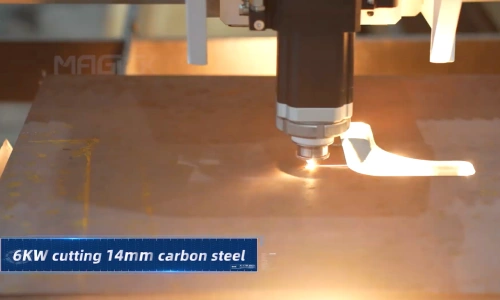
A laser cutting system directs and focuses a high-energy beam onto a localized area of steel. The concentrated beam heats the material until it melts, undergoes a chemical reaction, or partially vaporizes. A coaxial flow of shielding gas removes debris from the cut, while a CNC-controlled motion system guides the cutting head along a predetermined path. Thus, the gas and the laser work in tandem as integral components of the same process, rather than as independent systems. [1]
In oxygen-assisted flame cutting, oxygen reacts with the heated steel, providing energy through the oxidation process. This method is typically used for carbon steel and can handle thicker cuts, but it leaves an oxidized edge, which may affect subsequent welding or coating processes. In nitrogen-assisted fusion cutting, the laser provides the energy for melting, while the gas expels the molten metal; no reaction similar to that in oxygen-assisted cutting occurs. When the equipment, materials, gas supply, and process parameters are all appropriate, this method can produce edges with low oxidation.[1]
The production workflow begins before the beam reaches the sheet:
- Review the CAD file, drawing revision, units, and critical dimensions.
- Select the correct steel grade, thickness, and surface condition.
- Arrange the parts in a nest and define spacing, sequence, and common-line rules where applicable.
- Generate the cutting program, including pierce locations and process parameters.
- Load and position the sheet.
- Pierce the material and cut the programmed contours.
- Unload, separate, and sort the parts.
- Inspect critical features and record any cleaning or secondary work.
Treat these steps as one production cycle. A fast contour speed offers limited value if piercing, loading, part separation, or downstream cleaning dominates the job. For a closer explanation of beam focusing, material interaction, and assist-gas removal, see MAGICK’s guide to how a laser cutter works. [9]
Which Types of Steel Sheets Can Be Laser Cut?
Fiber laser cutting machines can process many types of steel plates, but simply specifying “steel” as the production specification is not sufficient. Steel grade, thickness, coatings, surface scale, flatness, and delivery condition all affect cutting results. Whenever possible, use materials obtained through regular procurement channels for test cuts. Demonstrations performed on specially prepared test materials may not accurately represent the actual steel plates delivered to the factory each week.
Mild Steel and Carbon Steel
Low-carbon steel is widely used in the manufacture of brackets, housings, frames, panels, and general sheet metal parts. Because production typically involves a combination of various thicknesses and geometries, low-carbon steel serves as a practical starting point for evaluating machine performance.
When preparing for trial machining, the actual steel grade and thickness should be specified, rather than simply labeling it as “carbon steel.” The surface condition—whether clean, scaled, oiled, pickled, or coated—must be documented. If oxygen is to be used, it must be determined whether the resulting oxide layer meets the requirements of subsequent processes. If the workpiece will proceed directly to welding, painting, or powder coating, the required edge preparation processes should be incorporated into the production cycle and cost assessment.
Thép không gỉ
When laser cutting stainless steel sheets, special attention must be paid to dimensions and exposed edges. This is particularly important when parts are visible or proceed directly to welding, polishing, or assembly processes.
304 and 316 are common examples, but they are not interchangeable in procurement specifications. Type 316 contains molybdenum and is suitable for applications requiring higher corrosion resistance; the steel grade should be determined based on the specific application and environment. Cutting parameters cannot compensate for improper material selection. [2]
Surface finish requirements must be clearly defined before test cutting. Specify whether discoloration, scale, scratches, or the need for additional cleaning are acceptable. If appearance is critical, provide approved samples or drawing annotations so that the supplier and production team have a consistent standard for evaluating the final result.
Galvanized and Coated Steel
For galvanized, painted, laminated, or otherwise coated sheet metal, the type of coating and its thickness or specifications must be clearly specified. Coatings can affect smoke and exhaust requirements, surface appearance, and process stability. Before testing the material, the supplier should confirm that the selected machine, exhaust system, and cutting process are appropriate.
Standard production stock materials should be used rather than uncoated alternatives. If the coating near the cut must remain visually intact, include this requirement in the acceptance criteria and inspect both sides of the workpiece.
High-Strength and Alloy Steel
High-strength steels and special alloy steels should be evaluated based on their specific steel grades and as-supplied conditions. Their mechanical and thermal properties may differ from those of general-purpose low-carbon steels. Therefore, representative tests should account for actual internal characteristics, edge requirements, and subsequent welding or forming conditions. Process assumptions for one alloy should never be applied directly to another alloy without verification.
How Thick Can a Fiber Laser Cut Steel Sheet?
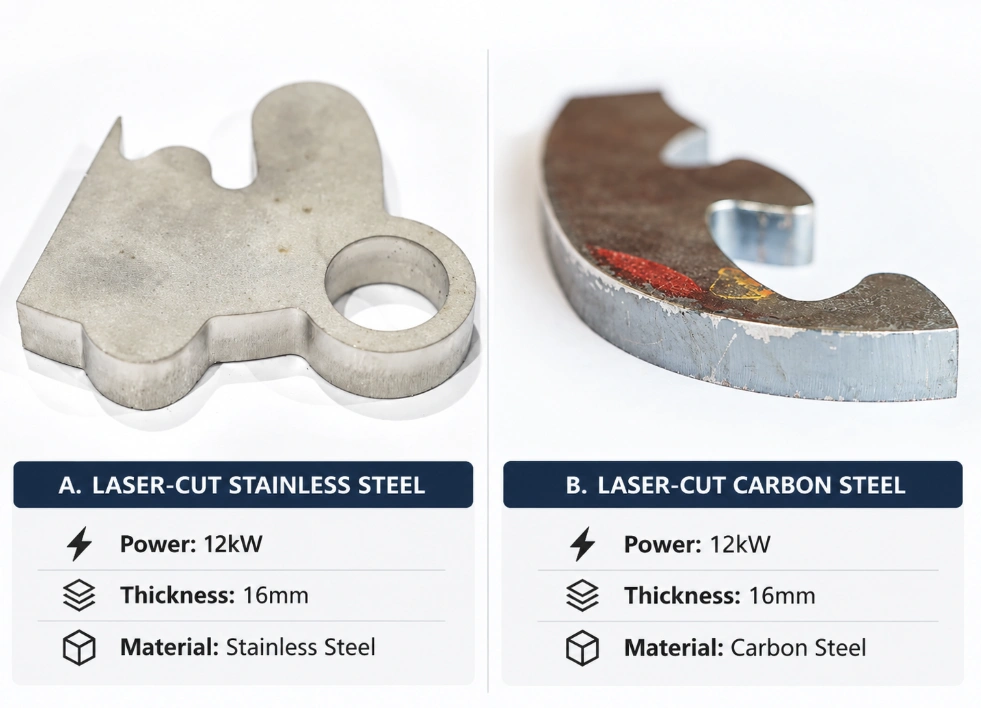
There is no single thickness limit that describes every fiber laser cutting machine. Capacity depends on the laser source, cutting head, optics, nozzle, gas supply, machine condition, material, and the quality and production rate required. A published maximum thickness is therefore a starting point for discussion, not a complete production specification.
Separate four different questions:
| Capability | What it demonstrates |
|---|---|
| Maximum piercing thickness | The machine can create a starting point through the material under stated conditions. |
| Maximum separation thickness | The machine can cut through the material and separate a simple profile. |
| Repeatable production thickness | Complete parts can be produced repeatedly with acceptable dimensions and edges. |
| Stable daily production range | The process can maintain the required output, quality, handling, and cost during normal shifts. |
For example, a 20-millimeter steel plate is approximately 0.787 inches thick. This is not the same as the nominal thickness (0.750 inches) of a 3/4-inch steel plate. If you are purchasing using imperial specifications, please provide the supplier with the exact nominal thickness and steel grade, rather than rounding it to a convenient metric value.
A useful test cut of thick steel should include the actual steel grade and thickness, representative holes and slots, tight corners, long contours, and the specified assist gas. Request a complete cycle time (including punching), not just the straight-line cutting speed. Inspect the top, bottom, and cut edges, then document any cleaning required before the workpiece proceeds to the next process.
Furthermore, a distinction should be made between occasional thick-plate processing and the thicknesses that account for the majority of the production schedule. Even if equipment is selected based on infrequent orders for the maximum thickness, it must still deliver cost-effective performance when processing thinner materials that account for the majority of its operating time.
Oxygen vs. Nitrogen for Laser Cutting Steel Sheet
Assist gas affects more than whether the cut succeeds. It influences the cutting mechanism, edge condition, gas infrastructure, cycle time, and work required afterward. Oxygen and nitrogen should therefore be compared on an accepted finished part, not only by gas price or maximum cutting speed.
| Evaluation factor | Oxygen | Nitrogen |
|---|---|---|
| Basic process | Supports an oxidation reaction that contributes energy | Expels molten material without the same oxygen-assisted reaction |
| Common evaluation point | Oxide layer and its effect on welding or coating | Gas pressure, flow, purity, consumption, and supply arrangement |
| Edge review | Dross, striations, taper, oxidation, and cleaning requirement | Dross, striations, taper, discoloration, and actual low-oxidation condition |
| Cost review | Gas use plus oxide removal or other secondary work | Gas use, supply infrastructure, and any secondary work |
| Selection basis | Accepted part quality and total defined job cost | Accepted part quality and total defined job cost |
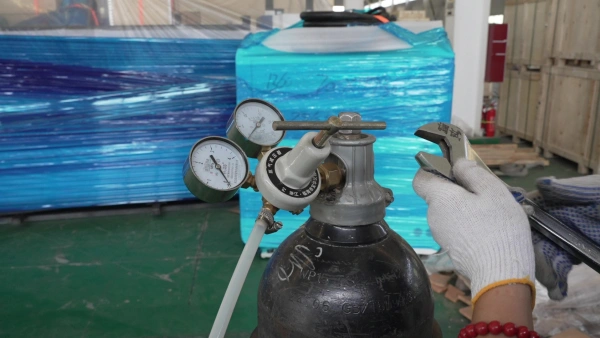
For carbon steel cut with oxygen, it is necessary to determine whether the oxide layer meets the requirements of subsequent processes. If the workpiece is to be welded, painted, or powder-coated, the surface treatment requirements should be determined in collaboration with the team responsible for that process. The cleaning or oxide removal process should be factored into cycle times and work order costs; the cut parts should not be considered finished products simply because they have been removed from the machine.
When low-oxidation cut edges are required, nitrogen is typically chosen, especially for stainless steel. However, selecting nitrogen does not automatically guarantee satisfactory results. Gas purity, pressure, flow rate, nozzle condition, focus, and machine settings must still be matched to the material and thickness. Air Liquide notes that high-pressure, high-flow nitrogen and high-purity oxygen are factors to consider regarding auxiliary gas supplies. [3]
Gas specifications and consumption should be recorded within measurable limits. Lower gas costs may be offset by longer post-processing times; even if the edge quality of the sample is ideal, costs may still be too high if the required gas supply configuration exceeds the plant’s budget. Before ordering equipment, gas requirements at the equipment connections should be confirmed, and it should be ensured that the equipment supplier and gas supplier collaborate based on the same operating assumptions.
Accuracy, Kerf Width, and Edge Quality
Machine positioning accuracy and finished part tolerances refer to different concepts. Positioning specifications pertain to the motion system under specified test conditions. The dimensions of laser-cut steel parts also reflect factors such as material properties, cutting parameters, kerf compensation, thermal conditions, drawing interpretation, and inspection methods. Positioning specifications should never be directly interpreted as a universal guarantee of every finished part’s characteristics.
The kerf refers to the width of material removed during the cutting process. The programmed toolpath must account for this to ensure the finished part’s contour meets the intended dimensions. Kerf width varies depending on material, thickness, geometry, beam parameters, and assist gas. Compensation should be managed within a controlled CAD/CAM workflow; manually offsetting drawings—only to inadvertently reapply compensation in CAM software—should be avoided. [4]
When conducting test cuts, critical dimensions should be determined before production begins. These may include mounting hole layouts, notches for accommodating another component, outer contours used for positioning in fixtures, or corners that affect assembly. After the workpiece has cooled, measure the verified features using an agreed-upon method and document the results against the exact drawing version.
Inspect edge quality separately from dimensions. Relevant observations include:
- attached dross on the lower edge;
- striation pattern and surface roughness;
- taper between the top and bottom of the cut;
- corner condition and heat accumulation;
- hole roundness and small-feature integrity;
- top-surface spatter or coating damage;
- cleaning required before welding, coating, or assembly.
A cut edge that looks acceptable in a photograph may still require preparation before the next operation. Conversely, a functional internal component may not need the cosmetic standard of a visible panel. Define acceptance around the application rather than an unsupported universal tolerance or “burr-free” claim.
Ask for several representative parts when repeatability matters. One successful sample is useful evidence, but it does not show how consistently the process performs across a nest or production batch.
Design Tips for Laser-Cut Steel Sheet Parts
The design of a production-ready laser-cut steel part begins with clear and well-defined geometry. Please verify the drawing units, export the file at the actual scale, and align the CAD file with the correct drawing revision. Before submission, check for open contours, duplicate paths, overlapping entities, and irregular geometry. Open contours may prevent the software from recognizing the contour as a closed cutting path, while duplicate lines may result in unintended repeated cuts. File cleanup methods vary by CAD platform, so please follow the specific requirements of the receiving CAM system. [5]
In accordance with the software workflow, distinguish cutting information from marking or engraving information. Dimensions, annotations, centerlines, and revision information should be retained in the accompanying drawings and must not be included as machine tool paths. Never assume that a particular color, line type, or layer name has the same meaning across all CAM systems.
Work with your equipment supplier to review small holes, narrow slots, slender bridging structures, and tight internal corners. Features that are feasible on thin sheet metal may require different processes or designs on thicker materials. Avoid applying a single minimum hole size rule to all steel grades, thicknesses, gases, and equipment configurations. If a feature is critical, include it in representative test cuts and clearly define the measurement method.
For text cut through the sheet, connect the internal islands of letters and numbers where needed. For nested parts, discuss spacing, lead-ins, cutting sequence, collision risk, and part stability with the programmer. A layout that uses slightly more material may still be more economical if it improves cutting stability and reduces rejected parts.
Material utilization should be measured by accepted parts, not only by the percentage of a sheet covered by geometry. Keep remnants identifiable and usable where practical, but do not sacrifice process reliability for a theoretical nesting percentage.
What Affects Laser Cutting Steel Sheet Price?
First identify which price is being compared. A subcontract laser cutting quote, the operating cost of an in-house machine, and the purchase price of a complete production system are different figures. They should not be presented as one number or compared without a consistent scope.
| Cost type | Items to include |
|---|---|
| Subcontract cutting price | Material, programming, setup, cutting, handling, finishing, inspection, packaging, and supplier margin |
| In-house operating cost | Material, gas, electricity, consumables, labor, maintenance allocation, rejected parts, and secondary work |
| Machine purchase price | Machine configuration, extraction, gas system, installation, training, software, and material-handling equipment |
Subcontract Cutting Price
A subcontract quote may be affected by material grade and thickness, sheet size, total contour length, number of pierces, part quantity, nesting efficiency, tolerance, edge requirements, and requested secondary operations. Two jobs with a similar sheet area can have very different costs if one contains many small holes and complex profiles.
When comparing suppliers, confirm whether material, deburring, oxide removal, inspection, packaging, and freight are included. Otherwise, the lowest cutting price may not be the lowest delivered-part cost.
In-House Operating Cost
For an in-house comparison, start with a representative job and count accepted parts. Record material issued, usable remnants, setup time, piercing and cutting time, loading and unloading, sorting, inspection, and secondary work. Add the applicable gas, electricity, consumables, labor, maintenance, rejected parts, and facility costs according to the company’s accounting method.
Material utilization deserves particular attention because sheet material can represent a major share of cost per part. Bystronic notes that programming, nesting, automated handling, and part sorting become increasingly important as cutting output rises. [6] More parts on a sheet can reduce material cost, but only if the nest cuts reliably and the parts can be removed without damage or excessive labor.
A practical comparison is:
Total defined job cost ÷ number of accepted parts = cost per accepted part
List everything included in the numerator so that another supplier or production team can reproduce the calculation. Keep rework and rejected parts visible instead of hiding them inside an optimistic output estimate.
Machine Purchase Price
For equipment pricing, request an itemized scope covering the machine, laser source, cutting head, table arrangement, enclosure, extraction, chiller, stabilizer where required, gas connection, software, installation, commissioning, training, warranty, and material-handling equipment. Confirm which items are included and which require separate purchasing.
What to Include in a Steel Sheet Cutting Trial
A representative cutting trial turns a sales demonstration into comparable production evidence. Use the same drawing, material specification, acceptance criteria, and cost boundary for every supplier. If each supplier receives a different test, the results cannot support a reliable decision.
| Trial item | What to document |
|---|---|
| Chất liệu | Grade, nominal thickness, measured thickness, surface condition, coating, and batch information where relevant |
| Part geometry | Small holes, slots, corners, long contours, text, and critical dimensions that reflect actual work |
| Machine | Model, laser power, cutting head, table configuration, and relevant options |
| Assist gas | Gas type, purity or specification, pressure, supply method, and consumption where measurable |
| Process time | Loading, positioning, piercing, contour cutting, table exchange, unloading, sorting, and complete cycle time |
| Inspection | Critical dimensions, hole condition, dross, striations, taper, corner quality, and surface damage |
| Secondary work | Deburring, oxide removal, cleaning, welding preparation, coating preparation, or other handling |
| Repeatability | Several parts across a representative nest or repeated cycle, not one selected sample |
| Acceptance | Drawing revision, measurement method, acceptable edge condition, and responsible approver |
Select at least three production cases: the most frequent material and thickness, the thickest recurring job, and a part with demanding geometry. If thin-sheet speed drives daily output, include a high-volume thin-sheet nest rather than testing only the impressive thick sample.
Keep the original cutting files, parameter record, gas information, photos, inspection results, and cycle-time video together. This evidence makes later machine comparison easier and reduces the risk that production starts from a different revision than the successful sample.
How to Choose a Fiber Laser Cutting Machine for Steel Sheets
Build the specification around real production jobs rather than laser power alone. Start with material grades, thickness distribution, sheet formats, monthly quantities, critical features, required downstream condition, and facility constraints. Then compare how each machine configuration supports those requirements.
A practical selection sequence is:
- Define the production mix. List the most frequent grade and thickness, the thickest recurring work, and the share of each in the schedule.
- Define the parts. Identify small holes, long contours, visible edges, tight dimensions, and downstream processes.
- Define the required output. Use accepted parts per shift or per week, not only maximum cutting speed.
- Evaluate the complete workflow. Include loading, unloading, sorting, remnants, programming, inspection, and bottlenecks at later operations.
- Confirm utilities and site conditions. Review electrical supply, gas supply, extraction, floor space, access, environment, and foundation requirements.
- Run representative trials. Compare complete parts under documented conditions.
- Review support. Confirm installation, training, troubleshooting, software support, consumable availability, warranty, and spare-parts delivery.
- Compare total cost. Calculate cost per accepted part and evaluate the assumptions behind projected output.
MAGICK offers several steel sheet laser cutting machine configurations with different table, enclosure, and workflow arrangements. [7] The correct configuration depends on how material moves through the factory and where waiting time occurs.
For example, the MK-E exchange-table fiber laser cutting machine allows loading and unloading on one table while cutting takes place on the other. [8] This can reduce waiting between sheets in batch production, but the benefit depends on job cycle time, operator availability, sorting requirements, and whether downstream operations can absorb the additional output.
Before final selection, verify who is responsible for installation, commissioning, operator training, and troubleshooting. Record response expectations and spare-parts arrangements in the quotation rather than relying on a general service statement.

Compare MAGICK Sheet Laser Cutting Machines
Choose the right configuration based on your loading workflow, production requirements, and enclosure preferences.
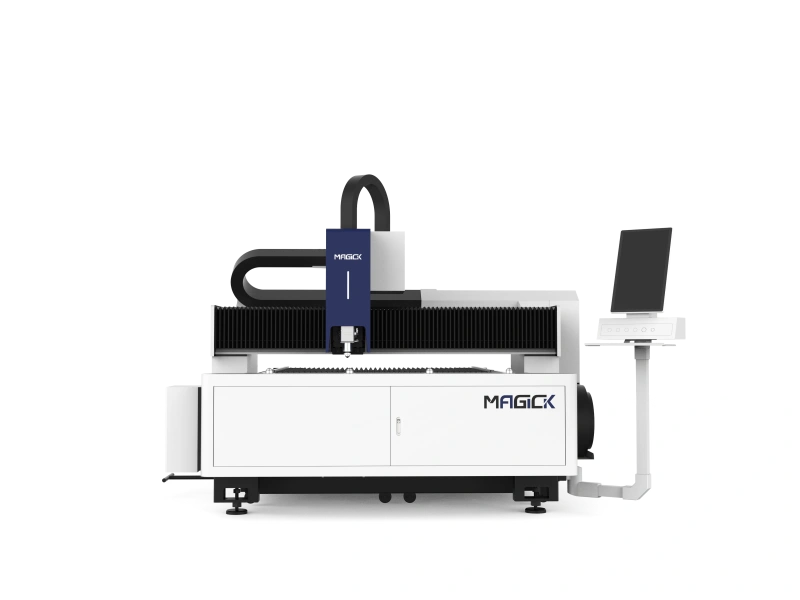
MK-S
Single Table Fiber Laser Cutting Machine
A practical solution for sheet metal cutting with a single worktable and a straightforward loading and unloading process.
Conventional sheet cutting where loading, unloading, and cutting are arranged in separate stages.

MK-E
Exchange Table Fiber Laser Cutting Machine
Designed to reduce loading-related downtime by allowing workpiece handling on one table while the other is cutting.
Batch production where operators prepare the next sheet while the machine processes the current workpiece.

MK-P
Fully Enclosed Fiber Laser Cutting Machine
Features an enclosed processing area with laser-protective viewing windows to help separate cutting operations from the surrounding workshop.
Sheet metal production where an enclosed cutting area, operator protection, and integrated equipment layout are important considerations.
Frequently Asked Questions
Can a Fiber Laser Cut 20 mm Steel?
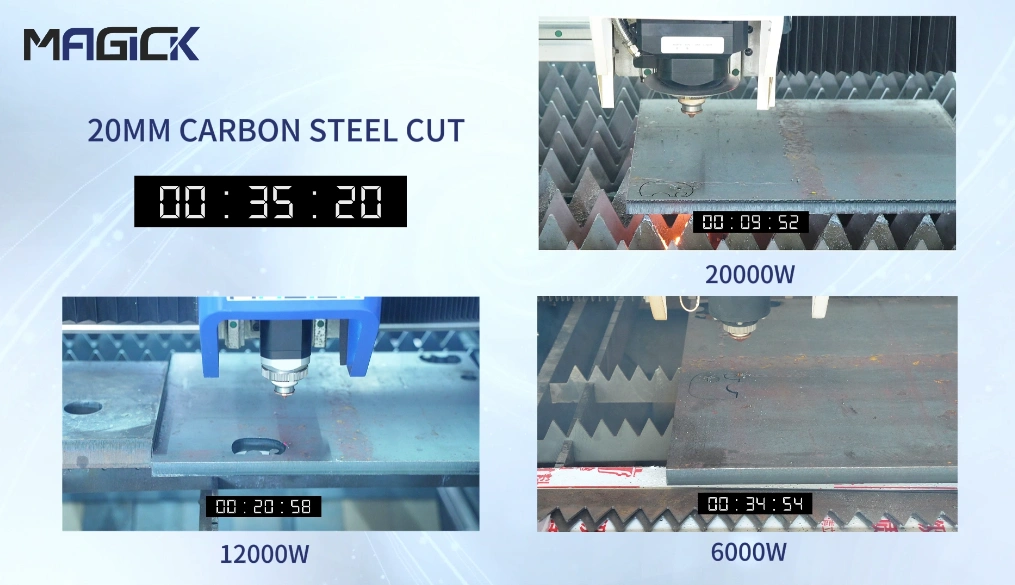
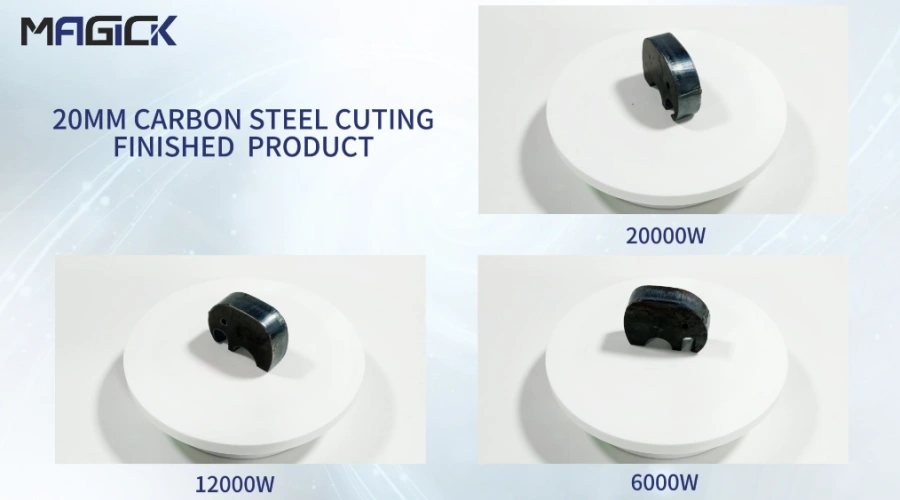
Some machine configurations can cut 20 mm steel, but the relevant purchasing question is whether the proposed system can produce the actual 20 mm parts at the required quality, repeatability, and cycle time. Request a trial using the exact grade, representative holes and contours, and intended assist gas. Inspect the complete part rather than accepting a straight-cut demonstration alone. Also confirm whether the job is occasional or a regular part of the production schedule.
What Determines the Tolerance of Laser-Cut Steel Parts?
Finished-part tolerance depends on the machine, cutting process, material, thickness, geometry, thermal condition, kerf compensation, CAD/CAM workflow, and inspection method. State the tolerance for each critical feature on the drawing and verify it through sample measurement. A machine positioning specification should not be used as a universal substitute for finished-part inspection.
Is Nitrogen Always the Best Gas for Stainless Steel?
No. Nitrogen is commonly selected when a low-oxidation edge is required, but the best process depends on thickness, edge acceptance, gas supply, cycle time, and total production cost. Compare representative samples under intended production conditions and include gas consumption and secondary work in the decision.
Does Laser-Cut Steel Always Need Deburring?
Not always. The need for deburring or edge cleaning depends on material, thickness, process stability, assist gas, part function, and downstream requirements. Define an accepted finished condition and record any work needed after unloading. A part that separates from the sheet is not necessarily ready for welding, coating, or assembly.
What Causes Dross on Laser-Cut Steel Edges?
Dross can result from an unstable combination of cutting speed, focus, gas flow, nozzle condition, material condition, and other process settings. Its presence should be evaluated on the actual material and geometry. Avoid diagnosing a production problem from a photograph alone; review the machine parameters, consumables, gas system, and material together.
What Information Should I Send for Machine Selection?
Send the steel grades, thickness range, sheet sizes, expected quantities, and representative drawings. Identify critical dimensions and required edge conditions. Include available facility information, gas options, current loading method, and any downstream process that limits output. These details provide a practical basis for configuring a machine and planning a cutting trial with measurable acceptance criteria.
Prepare for a Useful Machine Comparison
Laser cutting steel sheet successfully in production requires more than reaching a published maximum thickness. The machine, material, assist gas, programming, handling, inspection, and downstream operations must work as one system. The most reliable comparison uses representative parts, documented conditions, complete cycle time, and accepted-part cost.
To discuss a suitable MAGICK configuration, prepare your material grades, thickness distribution, sheet dimensions, production quantities, representative drawings, critical tolerances, and required edge condition. You can then compare MAGICK steel sheet laser cutting machines or submit the information for a cutting trial and configuration review.
Sources and Further Reading
The references below support the article’s explanations of laser cutting mechanisms, stainless steel grades, assist-gas supply, kerf, CAD preparation, production workflow, and the cited MAGICK machine configurations. They provide technical context rather than universal performance guarantees. Actual thickness capability, speed, tolerance, edge condition, gas consumption, and cost must be verified for the specified machine, material, geometry, and production conditions. Any future numerical performance table should identify its test method and source separately instead of treating these general references as measured MAGICK data.
[2] Outokumpu — Cold rolled coil, strip and sheet
[3] Air Liquide — LASAL lasing and assist gases
[4] SendCutSend — What is kerf in laser cutting?
[5] SendCutSend — Finding and fixing open contours
[6] Bystronic — Profiting with high-power fiber lasers
[7] MAGICK — Metal sheet fiber laser cutting machines
[8] MAGICK — MK-E exchange-table fiber laser cutting machine
