








Stainless steel laser cutting uses a focused beam to melt material while assist gas removes it from the kerf. It can produce panels, enclosures, signs, brackets and machine parts.
For production, the process must repeatedly deliver parts at the required dimensions, edge condition, cycle time and cost. Results depend on grade, thickness, finish, geometry, machine configuration and assist gas.
This guide explains how to evaluate those factors and prepare a meaningful equipment trial.
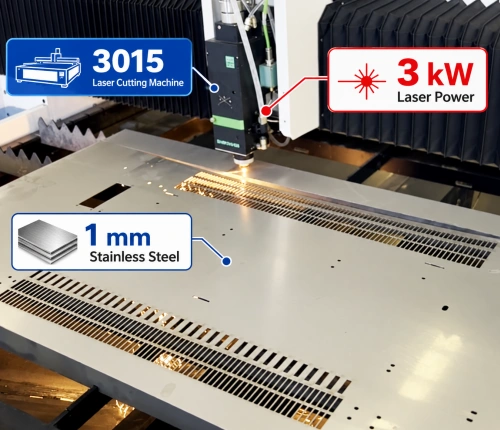
Nitrogen, Oxygen or Compressed Air?
The assist gas is important with regards to removal of the melted material, oxidation of the edges, consumption of the gas, and final polishing. When choosing the assist gas take into account the properties of the finished item and total cost of processing.
The nitrogen is widely used in cases when no oxides or minimum oxidation is desired. In the process of melting cutting inert gas removes molten metal and protects the edge from the environmental impact . Achieving the edge of the desired quality is thanks to the fact that the nitrogen does not contribute to heat due to oxidation and the laser is providing the required energy. [2]
The purity of nitrogen and its reliable delivery is also significant. Linde shows nitrogen is the typical gas for cutting stainless steel and ads that that the presence of oxygen leads to yellow spots and excess slag. The necessary level of purity, pressure, and speed depend on the particular machine, thickness of the metal, nozzle and required quality. [3]
Oxygen gives heat due to oxidation and thus leads to the appearance of oxidized edge. According to BSSA, it may accelerate the cutting process when compared to the nitrogen cutting having been slower under the conditions mentioned. The figures presented in the publications apply specifically to the specified 304 sheet and 1.5 kW CO₂ installation and are not connected to new MAGICK fiber lasers technologies. [4]
The compressed air can be also considered if the technologies are approved for the material and its thickness. However, since air has oxygen in its composition make a comparison in terms of blushing, dross and cleaning process with nitrogen injection. Calculating costs include energy of the compressor, drying, filtering, storage and servicing. Only devices approved for the material and thickness can be considered for use of compressed air.
| Assist gas | Main consideration | What to evaluate |
|---|---|---|
| Azot | Limits the same oxygen-assisted reaction | Edge color, purity, pressure, flow and supply cost |
| Oksijen | Adds process heat and creates an oxidized edge | Speed and preparation before welding or finishing |
| Compressed air | May reduce purchased-gas use on approved systems | Air quality, oxidation, finishing and compressor cost |
How Thick Can a Fiber Laser Cut Stainless Steel?
It is impossible to declare that a certain thickness of stainless steel can be cut by any fiber laser since the cutting process depends on multiple factors. Apart from power, there are several important aspects that determine the cutting process, such as the type of cutting head, nozzle, focusing optics, gas system, piercing method, and many others.
15kW Stainless Steel Laser Cutting Parameters
The following tables provide reference cutting parameters for 15,000W fiber laser cutting of stainless steel using nitrogen or compressed air as the assist gas.
Nitrogen (N₂) Cutting Parameters
| Thickness (mm) | Speed (m/min) | Pressure (bar) | Nozzle | Focus (mm) | Cutting Height (mm) | Frequency (Hz) | Duty Cycle (%) |
|---|---|---|---|---|---|---|---|
| 1 | 50–60 | 10 | 2.0S | 0 | 1 | — | — |
| 2 | 45–50 | 12 | 2.0S | 0 | 0.5 | — | — |
| 3 | 35–38 | 13 | 2.5S | 0 | 0.5 | — | — |
| 4 | 25–29 | 12 | 2.5S | 0 | 0.5 | — | — |
| 5 | 18–22 | 15 | 2.5S | 0 | 0.5 | — | — |
| 6 | 15–18 | 8 | 3.5B | 0 | 0.5 | — | — |
| 8 | 10–12 | 7 | 5.0B | 0 | 0.5 | — | — |
| 10 | 8–9 | 5 | 5.0B | -1 | 0.5 | — | — |
| 12 | 6–7 | 6 | 6.0B | -4 | 0.5 | — | — |
| 14 | 4–4.2 | 6 | 7.0B | -6 | 0.3 | — | — |
| 16 | 2.6–2.8 | 6 | 7.0B | -8 | 0.3 | — | — |
| 18 | 2–2.3 | 6 | 7.0B | -9 | 0.5 | — | — |
| 20 | 1.8–2 | 6 | 7.0B | -11 | 0.3 | — | — |
| 25 | 1–1.2 | 6 | 7.0B | -13 | 0.3 | — | — |
| 30 | 0.6–0.7 | 10 | 5.0B | -15 | 0.3 | — | — |
| 40 | 0.3–0.4 | 15 | 7.0B | +8 | 0.3 | 200–800 | 60–75 |
| 50 | 0.2–0.25 | 15 | 8.0B | +9 | 0.3 | 200–800 | 60–75 |
Compressed Air Cutting Parameters
| Thickness (mm) | Speed (m/min) | Pressure (bar) | Nozzle | Focus (mm) | Cutting Height (mm) | Frequency (Hz) | Duty Cycle (%) |
|---|---|---|---|---|---|---|---|
| 1 | 50–60 | 10 | 2.0S | 0 | 1 | — | — |
| 2 | 45–50 | 10 | 2.5S | 0 | 0.5 | — | — |
| 3 | 35–38 | 10 | 2.5S | 0 | 0.5 | — | — |
| 4 | 25–29 | 10 | 3.5B | 0 | 0.5 | — | — |
| 5 | 18–22 | 10 | 3.5B | 0 | 0.5 | — | — |
| 6 | 15–18 | 10 | 3.5B | 0 | 0.5 | — | — |
| 8 | 10–12 | 10 | 3.5B | 0 | 0.5 | — | — |
| 10 | 8–9 | 10 | 3.5B | -1 | 0.5 | — | — |
| 12 | 6–7 | 10 | 5.0B | -4 | 0.5 | — | — |
| 14 | 4–4.5 | 10 | 5.0B | -6 | 0.5 | — | — |
| 16 | 2.9–3.1 | 10 | 5.0B | -8 | 0.5 | — | — |
| 18 | 2.2–2.4 | 10 | 5.0B | -9 | 0.5 | — | — |
| 20 | 1.9–2.1 | 10 | 5.0B | -11 | 0.3 | — | — |
| 25 | 1.2–1.4 | 10 | 5.0B | -13 | 0.3 | — | — |
| 30 | 0.8–1 | 10 | 5.0B | -15 | 0.3 | — | — |
| 40 | 0.4–0.5 | 12 | 6.0B | -15 | 0.3 | — | — |
| 50 | 0.2–0.4 | 12 | 8.0B | -16 | 0.3 | — | — |
Note: These parameters are for reference only. Actual cutting performance may vary depending on equipment configuration, material conditions, and cutting requirements. Values should be verified before production. The symbol “—” indicates data not provided.
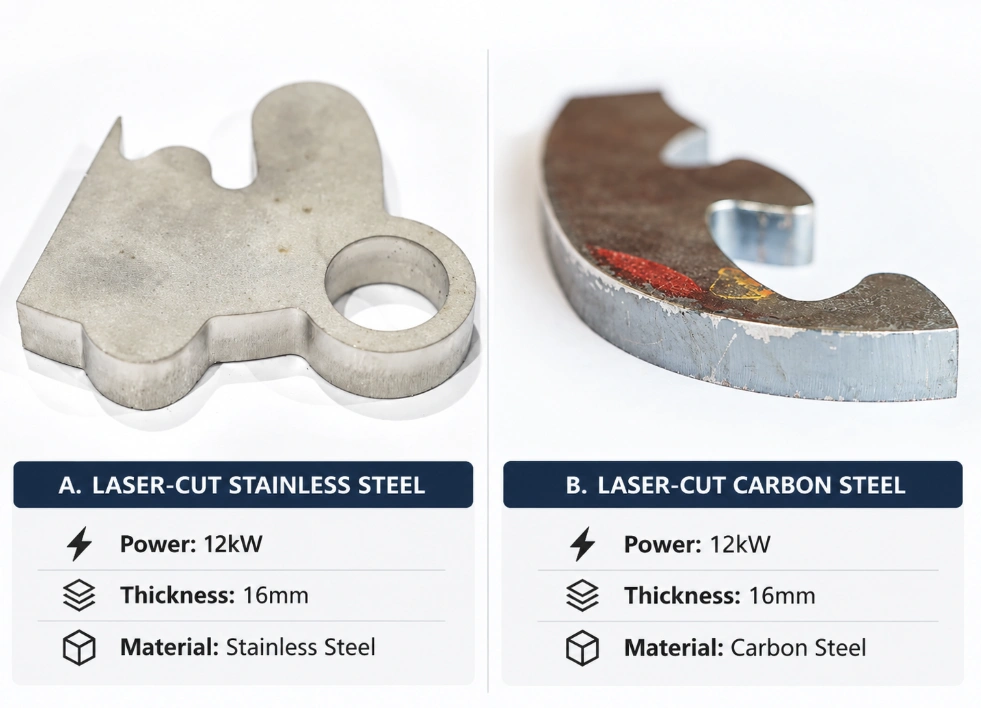
A maximum-thickness sample does not prove production capability. Ask whether the machine can pierce reliably, cut the required holes and slots, maintain corner quality and complete the part within the available time. Inspect both sides and record any cleaning required afterward.
Evaluate routine thicknesses as well as the thickest recurring job. Use a representative drawing with small holes, a narrow slot, corners and long contours instead of accepting a straight-cut coupon alone. Ask for several parts if consistency matters.
Cut Quality: Edges, Dimensions and Surface Condition
Before comparing samples, define acceptance criteria; for instance, a decorative panel, welded bracket, and food-component can be prioritized differently.
Inspect dross, striations, discoloration, taper, and corner condition on the entire cut edge and its underneath. After the run, measure critical hole centers, slot widths, tabs, and outside dimensions after cooling has occurred. The specification relating to positioning discusses the motion system; it does not guarantee that all tolerances for a finished part will be met.
Check the smallest holes, narrow connections and closely spaced features at the intended thickness. Minimum feature sizes vary with material and process, so establish them through representative trials rather than one universal rule. Inspect grain direction, scratches, handling marks and protective-film damage for visible parts.
These are investigation directions, not universal diagnoses. When a sample fails, record the defect and settings, then change one relevant variable at a time.
What Affects Stainless Steel Laser Cutting Cost?
The cost of laser cutting for stainless steel depends on the complete job. Main drivers include material grade and utilization, cutting length, number of pierces, small features, programming, loading, gas, electricity, consumables, unloading, inspection and finishing.
Distinguish three different figures before comparing suppliers, production methods, or making an investment decision:
| Cost type | What it should include |
|---|---|
| Subcontract price | Material, programming, cutting, handling, inspection and margin |
| In-house operating cost | Material, gas, power, labor, consumables, rejects and secondary work |
| Machine investment | Machine, gas system, extraction, installation, training and automation |
Compare alternatives using the same drawing, material, quantity and acceptance criteria. Calculate total defined job cost per accepted part, keeping rejects and rework visible. Include material remnants, setup time and downstream labor in the same scope. Lower gas expense may not reduce total cost if every edge needs cleaning, while higher cutting speed has limited value if unloading controls the cycle.
Cutting Trial and Machine Selection
A documented trial transforms an experiment into reliable proof of production. Give the supplier the same material, drawings, and specifications, and measure:
>grade, thickness, type of finish and protection;
>machine, laser power, cutting head, and nozzle;
>gas type, gas purity or specification, pressure, and way of supplying;
>charge, perforating, cutting, and unloading times;
>dimensions of the product, quality of the edges, holes, junction points;
>deburring and cleaning after the process;
>the number of parts produced under the principle of repeatability.
The right laser for cutting stainless steel is the one that produces accepted parts repeatedly within the planned workflow and cost. Match the configuration to regular grades, thicknesses, sheet sizes, quantities and demanding features—not only the occasional maximum-thickness job.
Examine isolated-table, transfer-table, closed and high-power setups regarding load and discharge, protection, workplace area and manufacturing quantity. Besides, study power supply, gas potential, collecting, refrigeration, setup, education, service and parts support.
MAGICK offers metal sac fiber lazer kesim makineleri in different formats and power ranges. Share representative drawings and normal production requirements so the proposed configuration can be evaluated with a useful trial.
Sık Sorulan Sorular
Can a CO₂ Laser Cut Stainless Steel?
CO₂ systems in industrial applications, coupled with the appropriate optics, power, and auxiliary gases are capable of cutting stainless steel. However, it is important to verify capabilities related to a specific machine and remember that a low-power engraving machine may not be able to cut sheet metal. [4]
Does Nitrogen Eliminate All Finishing?
No. Nitrogen can prevent oxidation but the finished parts might still require deburring, cleaning, polishing, or welding preparation. Check actual part for compliance with specifications.
Can Compressed Air Cut Stainless Steel?
It may be used on compatible systems approved for the specified material and thickness. Compare discoloration, dross, dimensions, compressor requirements and finishing with nitrogen on the actual job.
How Much Laser Power Do I Need?
Start with grades, distribution of thickness, dimensions, shape, quality, volume, and quantity of gases supplied. Always ask for proof of trials conducted. Power alone cannot assure quality and consistency of produced parts.
What Should I Send for a Recommendation?
Send CAD drawings, grades, thicknesses, sheet sizes, quantities, critical dimensions, finishes and downstream operations. Include floor space, utilities, gas options and the current production bottleneck. Identify which job is routine and which represents the maximum requirement.
Discuss Your Stainless Steel Cutting Requirements
A useful stainless steel laser cutting trial should show the finished part, documented conditions, repeatability, complete cycle time and work required afterward. Prepare representative drawings, material specifications and acceptance criteria before comparing proposals.
Contact MAGICK for a machine recommendation and sample-cutting discussion so the team can review capacity, gas supply, handling and installation requirements.
Sources and further reading